
FOREARM CRUTCHES:
Finding Balance with MS
For walking challenges brought on by multiple sclerosis or other chronic disability, forearm crutches are a great equalizer. The stability and confidence they provide is vastly superior to a cane and even trekking poles. But choosing the best forearm crutches can be complicated with so many choices available. Fortunately a few designs rise above the fray. ActiveMSers has tested and reviewed a range of Canadian/Lofstrand crutches and these are our recommendations.

When my multiple sclerosis got ornery in late 2009, I was forced to start using a walker. My legs just didn’t have the strength to get me where I needed to go. That bummed me out… and pissed me off. But then my physical therapist sister pulled out a 20-year old pair of beater forearm crutches that she had found stashed in the basement of her hospital. “Try these,” she said. Talk about a godsend. That simple revelation of using forearm crutches—also called Canadian or Lofstrand crutches—changed my life.
I went to myriad places that would have been off limits for a walker, from hiking in forests to playing on beaches to even snowshoeing in the mountains. Cobblestone streets and gravel roads were passable again on foot. Heck, navigating urban hazards like crowded restaurants, concerts and bars became a breeze. Along the way, I also discovered that forearm crutches themselves are an art form, and there is a world of difference between a well-made pair of sticks and those slapped together circa 1990.
In the following guide, ActiveMSers highlights the major areas to consider when purchasing forearm crutches based on sampling a range of forearm crutches. Let’s start by breaking down each variable to consider when purchasing forearm crutches.
Forearm crutches from Side Stix and M+D Crutches were donated for testing purposes. Members of ActiveMSers can save up to 15% on select forearm crutches with reserved coupon codes. To get your discount, join ActiveMSers today. NOTE: ActiveMSers has negotiated these discounts and has no other affiliation with these companies.
CONSTRUCTION AND SIZING
Forearm crutches typically are available in four different types of material: aluminum, titanium, plastic or carbon fiber. With so many construction options, choosing what material your forearm crutch boasts often comes down to your wallet thickness or quality of your insurance plan. Most inexpensive forearm crutches are made of an aluminum or steel composite. As you go up in price, you’ll find those along with a wide variety of other materials, including titanium, carbon fiber, and even wood. In the higher-end arena, titanium is lightweight, has impressive shock absorbing qualities and is strong. Carbon fiber is even lighter weight (shaving off up to a half pound per stick over aluminum), more shock absorbing, and stronger still. Like titanium, it’s also expensive. Recommendation: What you can afford
As for sizing, inexpensive forearm crutches have lots of sizing holes to fit lots of different body sizes, which helps keep the cost down due to mass production. They tend to be clunky and noisy with all the grace of a Roseanne Barr singing the national anthem. Of course you’d want a forearm crutch exactly customized to your body to fit you like a glove (not your gloves, OJ) or a hand-fitted suit with a dozen tailored measurements, right? Not so fast. Say you want to get down that scree field on Kilimanjaro after an exhausting summit day? You’d definitely want to extend your crutches at least a couple inches for the long and unstable downhill. Some crutch manufacturers offer crutches with infinite adjustability. Although a tool might be required, this gives the user maximum flexibility. If you don’t plan to do a lot of crazy adventures with your crutches, fixed is a fine way to go. Recommendation: Depends

TIPS, GRIPS, AND CUFFS
TIPS
So this one time I had to make a pit stop at a gas station due to a wee bit of, ahem, need to wee. As is always the case when I REALLY have to go, the entire station was just mopped (aka, flooded). After gingerly making my way to the bathroom with my beater crutches, fearing for my safety with every step, I set them against the wall only to watch them both slide onto the wet tile floor in ear-splitting fashion. The poor store attendant was certain that I had fallen, cracked my skull on the condom machine, and died in her restroom. And that it was all her fault for such sloppy housekeeping. I did manage to get out before funeral arrangements had been made, but this tightrope exposed my beater crutch tips, slick as ice on wet floors, as barely a notch above Ford Pintos and lawn darts for safety. If there is one area where high-end and budget crutches differ shockingly, literally, it’s in the tips. Thomas Fetterman patented a crutch tip technology with a built-in shock absorbing system back in 1988 and it remains the industry gold standard. They bend into the floor, to give you mountain-goat footing, while the gel shock absorption is comfortable and predictable. Wet floors? No problem—Fetterman claims 300% more wet-slip resistance over standard rubber. I believe it. They also have a lightweight version that you should seriously consider. Recommendation: Tornado Tips, Standard or Air (Fetterman)
GRIPS
There are a number of different grips available for forearm crutches, and my PT sis steered me (wisely) to the type she feels is best: those with a wider base for the heel of your palms. Narrow standard grips, even those with padding or gel, still force much of your weight to the pressure point between your thumb and forefinger (picture doing dips on two pegs). In time, this can get painful and gel eventually loses its forgiving properties. A wider, flatter grip—tapering to a narrower end—allows you to distribute your weight better and efficiently control your stick, and is far more ergonomically friendly in my opinion. Recommendation: Ergonomic Grip
CUFFS
The most basic decision you’ll have to make regarding cuffs for your forearm crutches boils down to the opening: side, front, or 3/4. I’d nix the 3/4 for MSers because it just doesn’t provide enough support. Between front and side, both have their advantages. Front openers may offer a touch more side-to-side stability and stealthiness (if forearm crutches could ever be stealthy), while side openers are better for daily living (your crutch won’t slip when you lift your arm) and are the most popular. In terms of material, there’s generic and inexpensive metal (often vinyl-coated) that you can bend to size, and custom-molded plastic complete with leather padding. Often the padding can be removed or the cuff can be enlarged on the fly to accommodate bulky coats. Recommendation: Side Opening

EXTRAS: SHOCK SUSPENSIONS & ATTACHMENTS
Some higher-end crutch manufacturers offer a suspension system within the main shaft of the crutch to offer increased shock dampening. This is a great concept and one I would highly recommend in particular for those who use the crutch for significant weight bearing (e.g., amputees) or for significant distances (e.g., hikes lasting hours), but the benefit may not be as appreciated by those with multiple sclerosis if the shock is too “bouncy.”
Some shock systems add “fuzziness” and might not provide the same confident feedback as a rigid crutch. Ideally you’ll get just enough damping to reduce upper body fatigue but not enough to throw off your balance. Indeed, it is so seamless, you likely will not even be aware that the shock is helping you with every step. Now, there also are some basic drawbacks, as the feature always adds price and weight, and requires more maintenance. But for a hike, they are invaluable. Since I’ve not tested other systems, I can only recommend the SideStix shock, as its rebound is slight and totally predictable, which may not be the case with other crutches. Proceed with caution in this arena at lower price points. Recommendation: Depends
While most forearm crutches offer few if any attachments, both SideStix and Fetterman have a range of extras. Fetterman offers low-cost ice tips and beach tips and even an attachment for carrying luggage. SideStix ups the ante further with their unparalleled commitment to the outdoor enthusiast: an 8” snowshoe, a 4” sandshoe, a spindle/ice pick, and grip caps. The spindle pick turns your forearm crutches into trekking crutches with its stainless steel center spike, ideal for the trail and anything it throws at you—dirt, ice, roots, rock. Add the sandshoe (spindle pick required) and you’ll have the traction and float to go through sand, crusty snow, and mud. The snowshoe, made of the same aircraft aluminum and PVC-coated polyester mesh as the sandshoe, offers an even wider platform to get you through powder snow. In testing, most terrain could be traversed without any of these extras, but they sure do make it easier. If you plan to use your forearm crutches for one activity extensively (say, going to the beach regularly), the added sand shoe accessories from SideStix would be invaluable. But I often found I didn’t hassle with the swap if it was a quick adventure. On the other, if you just need to get traction on ice or packed snow on the fly (and go back to your standard tips quickly), slipping relatively inexpensive grip caps over your existing crutch tips is convenient and easy. Recommendation: Grip Caps + Your Passion
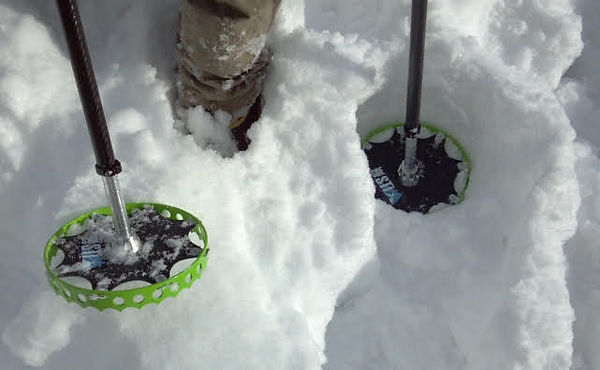
SideStix snowshoe attachment.

SideStix spindle pick attachment.

INTANGIBLES
There are several other areas to consider when purchasing a new pair of forearm crutches that go beyond their basic construction.
Noise. Well-made fixed-length and infinite-length crutches are whisper quiet. Metal? Not so much. My beaters basically featured a “Dave approaching” early-warning system, as folks could hear me—lots of metal-on-metal—from a block away.
Weight. You can buy crutches so light they almost float on air. And they tend to be cheap, plastic, and disposable. When deciding on a pair of crutches, weight matters most where it counts (primary shaft), but quality trumps in other areas (tips, grips, cuffs).
Grip Angle. Carpal tunnel syndrome and forearm crutch use can go hand-in-hand. SideStix actually scientifically developed their grip angle to minimize this risk, canting it up ever so slightly (actually a technical challenge), making it an unsung and unusual benefit of the crutch.
Travel/Portability. This sounds great on paper but in practice is rarely recommended in a crutch. These collapsible types are not typically appropriate for day-to-day use. That said, if you primarily use a wheelchair or scooter and want to have a pair of crutches on hand for those occasions when you need to get around in tight spots, perfect.
Price. Cost is a huge variable. Forearm crutches range in price from $25 for the most basic drug-store versions to over $1,000 for those custom-made. Health insurance can soften the blow.
Warranty. Less expensive crutches, which can wear quickly especially for full-time crutch users, often have short warranties. Look for lengthy or lifetime warranties if you plan to put the crutches to serious use.

FOREARM CRUTCH ALTERNATIVES
Traditional forearm crutches aren’t for everyone. Some users do not have the wrist strength or arm stability to operate them safely. In the States, underarm crutches are the standard for a busted leg or twisted ankle, but comfort severely lags, and they are not a good long-term solution. Wrists get impinged, shoulders get achy, and armpits get sore. Those little knee scooters are an alternative when you have a lower-body injury, but that’s not practical for leg weakness typical of multiple sclerosis. Enter the type of crutch that supports users by the elbows.
One example is the M+D Crutch, which we also tested. Unlike many crutch users (in particular amputees), I didn’t regularly use a swing gait (moving both poles at the same time), instead using the crutches like trekking poles—opposite leg, opposite pole. I had to reprogram my brain to use crutches with a new gait—these work best together, with elbows close but foot pads wide—which took time to get used to. Used this way, like doing a dual bicep curl, the benefits of this type of crutch became more pronounced. With elbows bearing the lion share of the weight, walking feels almost effortless.
But there are issues with this type of crutch. They are a bit bigger and awkward to use than a simple forearm crutch. They are also notably heavier. The bells and whistles on some sound whiz-bang—the M+D Crutch has drop away grips, perfect for shaking hands or grabbing a Cheeto puff—but in practice these extra features were rarely put into use in the real world. That said, for those unable to use traditional forearm crutches due to upper body strength or pain issues, these crutches will feel like a revolution.

ACTIVEMSERS RECOMMENDATIONS
Buying forearm crutches is a lot like buying a new car. Anything you purchase will technically get you from Point A to Point B. Do you need to spend a grand to get a decent pair of forearm crutches? No. You also don’t need that sports car (or high-end bike or insert pricey passion here) in your garage, either.
If you have never used forearm crutches, your budget is snug, or you are on the fence, I’d recommend purchasing an inexpensive pair to try out or renting a pair. (TIP: avoid using insurance for an inexpensive pair, as you probably are allowed this type of purchase only once every five years or so.)
While I found using forearm crutches much less fatiguing than using a walker (since it allowed me to take better advantage of my upper-body strength) you may have a different experience. Using them also requires a modicum of balance, albeit far less than one might imagine. In fact I’d never fallen using a pair. Interestingly, I looked like I could barely hobble around my house with my walker, but I could walk confidently with forearm crutches. Lastly, they can take time to learn how to use properly. Since I’d hiked with trekking poles for years, the transition was easy for me, but may take time for novice users.
TOP PERFORMER: SideStix ($350+)
After using my beaters for two years and then testing the SideStix, I learned that there is a vast gulf between hand-me-downs and high-end. Does SideStix make the best forearm crutches on the market? For the outdoor enthusiast, there’s no question—absolutely. Developed by physical therapist Sarah Doherty, who lost a leg years ago to a drunk driver, SideStix gave her moxie. After the accident, Sarah went on to become a member of the US Disabled Ski Team and was the first amputee without an artificial limb to climb both Rainier and Denali on crutches.
Every component—from the carbon fiber shaft to the grips to the custom-molded cuffs to the limited lifetime warranty—sets the bar incredibly high. But note that the price quickly ratchets up with goodies. We especially loved the lightness of the carbon fiber and the dampening of the shock. Even the grips impressed. SideStix actually started by borrowing from the high-end cycling accessory company Ergon to source their original grips: the BioKork version of the GP1. Made of lightweight cork, which has natural damping properties and is both antibacterial and hypoallergenic, these grips are dynamite and can be easily adjusted to any angle to fit snugly in your palms. Plus all your bike geek friends will run over and say, “Rad, Ergon grips.” Really, they will. Then SideStix introduced the Fin Grip, a grip they developed over several years of R&D, which are fantastic. I was blown away by the versatility of these go-anywhere Canadian crutches, their performance amplified by the diverse array of outdoor accessories. They are our top recommendation for the disabled athlete, adventurer or explorer.

TOP PERFORMER: Fetterman Crutches ($550+)
Thomas Fetterman has been using crutches since 1953 due to polio. In 1988 he invented his highly acclaimed crutch tips and success tumbled from there, as he leaned on his design and personal experience to develop some of the best forearm crutches in the world. Indeed, he’s sold nearly 100,000 pairs and his “artwork” is renown. Like SideStix, he has developed performance cuffs, handgrips, and more. His signature crutches are made of titanium, using the skills from leading wheelchair manufacturer TiSport. His LiteStix ratchet into the low four figures and are custom sized to the user. The titanium is bulletproof and forgiving, absorbing shocks and vibrations. But it’s the attention to detail that impresses here. The nylon cuffs alone took over a year to develop and cost over $30,000 in R&D expenses. We’ve already gushed about the tips, and there really is no comparison. Indeed they are the standard on our other fave crutch, SideStix. While the two manufacturers are technically competitors, they play well together and play off each other’s strengths. As an option, Fetterman offers the custom SideStix Fin Grip, a grip we felt excelled. Fetterman crutches come with a 10-year warranty, but their bombproof construction means that likely would never be an issue.

ALSO CONSIDER: M+D Crutches ($200+)
If you have issues with your shoulders, wrists or hands, the type of non-forearm crutch made by Mobility Designed is a fine solution. Because of its unconventional weight distribution, the M+D Crutch allows your elbows to bear much of your body weight, and the innovative design has many smart touches. Priced aggressively, they won't break your budget either. But these crutches aren’t for everyone.

ALSO CONSIDER: Walk Easy Crutches ($150+)
Yes, you can find crutches for sale for under $100. Even under $50. But if you are going to use them longer than a few weeks, invest in something decent. Walk Easy crutches are affordable, well-made, and come in an array of splashy colors. Sure, the cuff is front entry, but the grip is ergonomic and there is even a small safety reflector. Bottom line: a solid crutch at a solid price, and a great introduction to forearm crutches.
